

It is Sunday evening and you are still paying for Saturday. Nothing you did was remarkable, some yard work, a long walk, a late dinner with friends, and here you are at eight o'clock with your feet up and Monday already leaning on you.
Nothing has changed on paper. Same job, same hours, same garden. What changed is the recovery, and the tiredness has a quality a full night does not entirely fix. People call that getting older, which is a fair description and a poor explanation. The inflammation half of this story lives in grounding and the immune system. This piece stays with the wear itself.
So do grounded sheets work on any of that? Here is what has been measured, what has not, and what to do with the difference.
The Short Answer to Do Grounded Sheets Work
Electrically, yes, and that half is not in dispute.
A grounded sheet is woven with conductive fiber and wired to the ground port of your outlet, which has been connected to a metal rod in the soil since the house was built. Lie on it and your voltage comes down to match the earth under the building. A voltmeter shows the change in seconds. That is the whole premise of earthing, a measurement rather than a claim.
The biological half is where the real argument sits. The premise is that electrons drawn up from the earth can act as antioxidants, settling the surplus reactive molecules in tissue that has stayed inflamed longer than it needed to.
Nobody has watched that happening inside a living person, and that should be said plainly. The reason to take it seriously anyway is that the claim makes a prediction somebody can check, and people went and checked, with cameras, with blood drawn before and after, and with hormone assays that do not care what anyone believes.
So the honest answer has two parts. The physics is settled. The biology is research based, pointing in one direction.
The Apple on Your Counter Is Doing What You Are Doing
You have already watched this happen, on a plate, in your own kitchen. The cut apple went brown. Nobody touched it. It met the air, and oxygen pulled electrons out of the fruit until the fruit was a different color. That is oxidation, and a slower version of the same chemistry runs inside you every second you are alive.
A free radical is a molecule missing an electron. That is the whole idea, everything after this is details. Electrons prefer to travel in pairs, so a molecule with an unpaired one is restless, and it takes an electron from whichever neighbor is closest. The neighbor is now the one short, so it does the same to the molecule beside it. Picture a row of people each stealing a coat from the person next to them. One theft becomes a chain, and the chain travels.
When the molecule being robbed is part of a cell membrane, a protein or a strand of DNA, the theft leaves real damage. Enough of that accumulating is what researchers mean by oxidative stress. Notice the word accumulating. Oxidative stress is not the presence of these molecules, it is the point where damage is produced faster than the body clears it, which is a fair description of how Sunday evening feels.
Your body makes them on purpose, though, so lower is not the goal. Energy production throws them off, immune cells use them as ammunition, others carry signals that tell muscles to adapt after a hard session. What you want is not a clean system, it is the clearing up staying ahead of the damage.
The Aisle You Have Walked Past a Hundred Times
Take the marketing off the word antioxidant and very little is left, in the good sense. Vitamin C, vitamin E, glutathione, the polyphenols in a blueberry, all share one property. They are stable enough to give away an electron without turning destructive themselves. They hand one over and the chain stops. An antioxidant is an electron donor.
Which is why the grounding proposal is less strange than it sounds. If an antioxidant is a molecule that donates electrons, and the surface of the planet carries a continuously restocked supply of them, then skin contact with conductive ground is at least worth asking about.
Notice how different that is from swallowing a capsule. A supplement is a flood. You take a large dose, it circulates everywhere, and much of it lands where nothing asked for it, including tissue where those molecules were doing legitimate work.
A reservoir behaves the other way around. The electrons sit there available, and the chemistry draws on them where something is out of balance, at the border of an inflamed area, at the moment it matters. The earth is not a dose, it is a supply, kept topped up by the planet itself. A tap and a bottle hold different amounts of water, and only one of them runs out.
Does Any of It Reach the Part That Is Sore
James Oschman's proposal is that your connective tissue carries electrons. Collagen is everywhere in you. It wraps every muscle, sheathes every organ, and runs without a break from just under the skin down to your deepest tissue as one continuous web. Under the right conditions it passes the charge along rather than blocking it, which is not what most people would guess about the material holding a body together.
So the picture stops being a body of separate parts. It becomes one connected conductive fabric, and contact at a shoulder blade stops being a local event. The measurements keep converging alongside it. Chevalier's thermal imaging showed inflammatory hot spots cooling over weeks. Two hours of contact was enough to change what came out of a needle, red cells holding a stronger charge on their surface afterward and sitting in fewer clumps.
Brown compared grounded people against a sham group after hard exercise and found the recovery markers moving differently. Cameras, blood work and heart rhythm recordings have nothing in common. However, the results keep leaning in the same direction.
Where the Hours Come From
Sustained contact is what every study reporting an effect uses. That is the one instruction this research gives plainly.
Outdoors is free and always was. Thirty minutes barefoot on grass, soil, sand or unsealed concrete grounds completely. Dry pavement, sealed floors, decking and rubber soles carry nothing and prevent grounding.
What fails here is consistency, never effort. Nobody quits because thirty minutes on the lawn was difficult. They quit because it rained for a week and then it was November. Night is the longest uninterrupted block anyone has, which is why the sleep research was extensively conducted.
What Four Weeks Will and Will Not Tell You
Be realistic about the timeline. Disappointment usually comes from expecting the wrong thing on the wrong day.
Sleep is what people tend to report first, often inside the first week or two. Stiffness and recovery shift more slowly. A single good Tuesday or a flat Thursday tells you nothing worth acting on.
A grounded sheet is no substitute for sleep, water, movement or a doctor, and it was never measured as though it were.
Write down where you are starting before you start. Nobody recalls last month's sleep accurately, which is the reason for putting it on paper. Here are some suggested indoor earthing products to assist with sleep:
The grounding mattress cover holds the contact all night, the longest uninterrupted stretch anyone has managed to study.
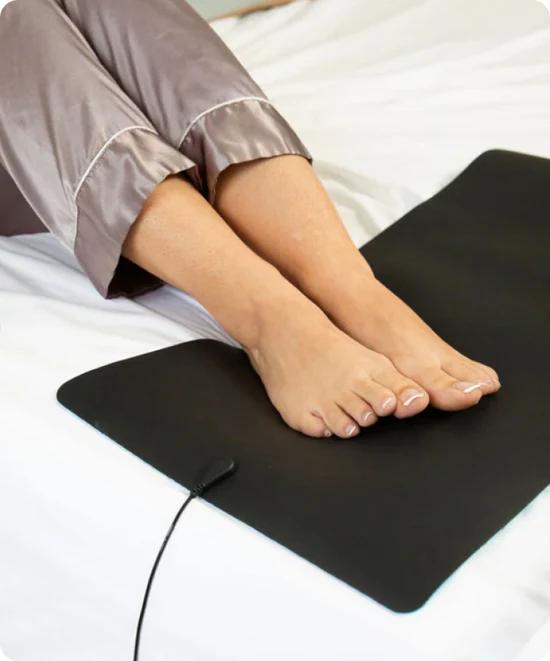
Grounding mats put you in contact while you sit, which is how the shorter sessions were run.
Grounding accessories such as patches and bands concentrate it on one area, useful when the wear is in a particular place.
Test your outlet with a plug in checker first, since older houses are not always wired the way the paperwork claims. Earthing products connect to the ground port alone and carry a built in safety resistor, so no electricity flows into you.
Grounding is a complementary wellness practice that supports the body's natural balance. It is not a treatment for any medical condition, and it belongs alongside your existing care.
Frequently Asked Questions
Do grounded sheets work, or is it an ordinary sheet with a cord?
They work electrically. A grounded sheet is wired to the ground port of your outlet, so it brings your body to the earth's potential the way bare feet on damp grass would. A voltmeter confirms it in seconds.
What is a free radical in plain English?
A molecule missing an electron. Electrons travel in pairs, so a molecule with an unpaired one takes a replacement from its neighbor, which leaves the neighbor short and starts a chain. Run that chain through a cell membrane and it leaves damage.
Is grounding the same thing as taking an antioxidant?
Not quite. Both come down to donating electrons, but a supplement is a dose that circulates everywhere, while the proposed grounding mechanism is a supply drawn on only where the chemistry calls for it.
How much grounding is the right amount?
It is not really a dose. Your body equalizes to the earth's potential rather than stockpiling charge, the same as on a long barefoot afternoon. The studies used sustained nightly contact, so that is the pattern to copy.
How long before I would notice anything?
Timelines vary. Sleep is what people tend to report first, often inside the first week or two, while stiffness and recovery shift more slowly. Give it a month before you judge it.
Test It on Your Own Sheets
The apple browns whether or not anybody is watching, and a gentler version runs in you all week. Whether a month of grounded nights changes how Sunday evening feels is something you can settle yourself, with a plug in checker and a note written before you begin.
Earthing.com is the origin brand, founded on the work of Clint Ober, who funded much of the research described above rather than simply selling around it. Explore the grounding collection and let the test run while you sleep.


Leave a comment
This site is protected by hCaptcha and the hCaptcha Privacy Policy and Terms of Service apply.