
Your hands are cold in a room where nobody else has thought about the temperature. You carried the groceries ten minutes ago and your fingers still have not come back to normal, and by four in the afternoon your legs feel heavier than anything you actually did today can account for.
Nobody investigates cold hands. They are not urgent, so they stop being a symptom and quietly become a fact about you, filed under circulation, which is a true answer and a useless one because it never tells you what circulation is doing differently. The wider electron story, spare electrons and the damage they might settle, lives in the work on oxidative stress. This piece stays with the blood, and with the reason grounding blood viscosity became a research question rather than a slogan.
Why Your Red Cells Keep Their Distance
Every red blood cell you own carries a slight negative charge on its outer surface. They all carry the same kind of charge, so they push each other away. It is the same refusal you feel holding two fridge magnets the wrong way around, that quiet insistence on a gap you cannot close without leaning on it. That shove is a large part of why your red cells travel as separate discs rather than clumps.
How hard they push can be put on a number, and that number is what the researchers went after. Stronger push, the cells keep their spacing. Weaker push, they drift together and settle into each other.
The measurement is old, and it did not come out of medicine. It has been in use for about a century wherever small particles have to stay evenly spread through a liquid instead of sinking into sludge at the bottom of the tin. It’s the same question, only blood has a body attached to it.
What the Grounding Blood Viscosity Research Actually Did
Chevalier and colleagues took that century old measurement and pointed it at earthing.
The design was plain. Blood was drawn from healthy adults, each person then sat connected to the earth through conductive patches for about two hours doing nothing in particular, and a second sample was drawn afterward. Both samples were measured for the charge on the cell surfaces, and counted for cells sitting in stacks.
Two things came out of it. The charge was stronger after the grounded session than before it, meaning the cells were pushing each other apart harder, and there was less clumping. Read as a pair, that is a picture of blood spacing itself out, and the authors described the result as reduced viscosity after earth contact.
These are small unbiased studies directly derived from examining the blood of each individual involved.
Why the Ground Is a Reasonable Place to Look
The proposal sitting underneath all of this is not exotic, and Oschman has spent years setting it out.
The planet's surface sits at a slight negative potential, which is a formal way of saying there is an enormous and constantly restocked supply of free electrons under your feet. Your body conducts. Put skin against grass, soil, sand or unsealed concrete and you come to sit at the same electrical potential as the earth underneath you. A voltmeter reads that change in seconds. That part is not a matter of belief.
So if earth contact makes electrons available, and if the spacing between your red cells is held by the charge on their surface, then a shift in one is a sensible place to go looking for a shift in the other. That chain asks only that electrons do what electrons always do.
The blood work does not sit on its own either. The immune and inflammation research follows what happens when tissue stays irritated longer than it should, which is the same story from another angle.
Finding Hours You Already Have
The measurement described above came after sustained contact, and that is the one instruction this research hands you plainly.
Start with the version that costs nothing. Thirty minutes barefoot on grass, soil, sand or unsealed concrete grounds completely. Gardening counts. Wet sand counts double. Sealed or painted concrete will not carry the charge, and neither will asphalt or decking.
What limits people here is the calendar, never the effort. They quit because the evenings went dark and the ground went cold, and if your hands are already cold in September, standing on wet grass in January is the last thing you are going to volunteer for. For this reason, indoor earthing products are advantageous especially during sleeping hours.
The First Month, Honestly
There’s no big announcement. Don’t expect warmth at the point of contact, tingle or hum. Sleep is what people tend to report first, often inside the first week or two. Anything else moves more slowly. A few feel something less pleasant at the start, mild aching or a restless first couple of nights, and it usually settles within a week.
Write down where you are starting before you start. How cold your hands are at eleven in the morning. How your legs feel at four. Nobody remembers last month accurately, which is the entire reason for putting it on paper. Here are some suggested indoor earthing products:
The grounding mattress cover holds the contact all night, far longer than any of the blood measurements ever ran for.
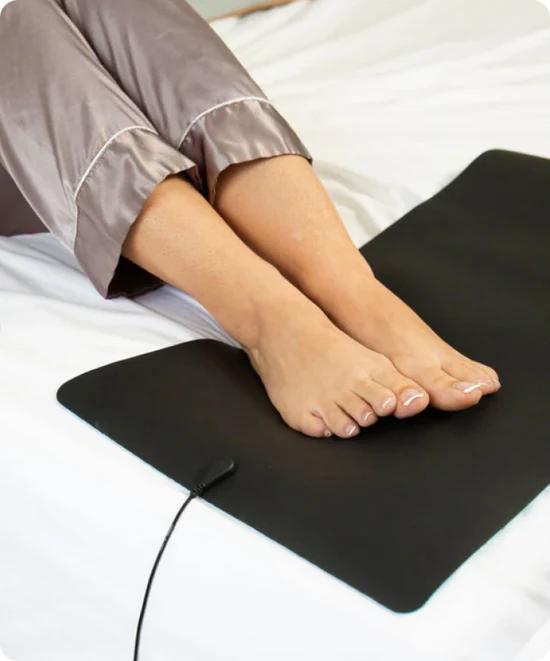
Grounding mats match the couple of hours seated that the blood work actually used.
Grounding accessories such as patches and bands sit close to the hands and feet, where people notice circulation first.
Test your outlet with a plug in checker first, since older houses and rewired rooms are not always wired the way the paperwork claims. Earthing products connect to the ground port alone and carry a built in safety resistor, so no electricity flows into you.
Grounding is a complementary wellness practice that supports the body's natural balance. It is not a treatment for any medical condition, and it belongs alongside your existing care.
Frequently Asked Questions
What does grounding blood viscosity research actually measure?
Two things. The electrical charge on the surface of red blood cells, and how many of those cells are clumped together. A stronger charge and less clumping go with blood that moves more easily through the small vessels.
Why do red blood cells push each other apart?
Because every one of them carries the same kind of charge, and two things holding the same charge shove each other away. That shove is what keeps your red cells traveling as separate discs instead of settling into stacks.
Why would clumping matter in the small vessels?
Because that is where the handover happens. Cells have time to gather in the slow, narrow passages that feed tissue directly, and blood carrying stacked cells needs more pressure to cover the same distance.
Do I have to buy anything to try this?
No. Grass, damp soil, sand and unsealed concrete are all conductive, and half an hour standing or sitting on any of them connects you as completely as anything you can buy. Bedding and mats exist for the hours when going outside is not realistic.
Should I talk to my doctor before starting?
Yes, if you take anything prescribed. Grounding is a wellness practice and not a medicine, and it cannot stand in for one. Tell your physician you are adding it, keep taking exactly what you were given, and leave every decision about your treatment with them.
Give Your Blood Room
A charge that keeps cells apart, a measurement borrowed from a century of chemistry, and a direction that held steady from one person to the next. None of that has to be taken on faith, which is what makes it worth a month of your own attention.
Earthing.com is the origin brand, founded on the work of Clint Ober, who funded much of the research described above rather than simply selling around it. Explore the grounding collection and put your feet back on the ground tonight.



Leave a comment
This site is protected by hCaptcha and the hCaptcha Privacy Policy and Terms of Service apply.