

Soreness is not the problem. Slow recovery is.
A hard session, a long hike, an afternoon of moving furniture, the ache that follows is normal and it is supposed to fade. What frustrates people is when it doesn't. The stiffness hangs around into the third day. The knee that used to settle overnight now complains for most of a week.
Most of the conversation about grounding and inflammation stays broad, and we have covered that wider ground in our research roundup on grounding and inflammation. This piece narrows to one question instead.
Here is what researchers have found about grounding and physical recovery after exertion, where the science looks most promising, and what it can realistically offer a body that is slow to bounce back.
What Soreness Actually Is
Inflammation gets treated as the villain of recovery, but it isn't.
When you load a muscle harder than it is used to, you create small amounts of damage on purpose. Your immune system answers by sending a repair crew. Blood flow rises, fluid moves in, and reactive oxygen species, molecules deliberately deployed to break down damaged tissue, go to work clearing the debris.
That whole process is inflammation, it is the reason you get stronger rather than just tired. The ache that arrives a day later has its own name, delayed-onset muscle soreness, and it is mostly the sound of the crew working.
Trouble starts when the crew never leaves. Chronic low-grade inflammation is the background hum behind most everyday aches, and a body already running hot has less capacity left for the acute repair job you just handed it.
You are asking for a clean-up on a site that was never cleared from last time. So recovery drags. Not because the session was too hard, but because the system doing the recovery was already busy.
Delayed-Onset Muscle Soreness Is the Cleanest Test
Researchers wanted a way to look at recovery that didn't depend on how anyone felt about grounding, so they built one.
Participants performed a standardized calf exercise designed to produce reliable soreness. Afterwards some slept grounded, and the rest slept on a system that looked and felt identical but had quietly been left disconnected. Nobody knew which one they had.
Over the following three days, the grounded group reported less pain. They also tolerated more pressure applied to the calf before saying it hurt, which is a measurement rather than an impression.
The study was small, and the researchers acknowledged that limitation. Even so, its carefully controlled design, with standardized effort and a sham comparison, adds real weight to the findings.
An independent group with no connection to the original investigators has since taken up the same question, testing grounded sleep after intensive eccentric loading, the downhill, lowering-phase work that leaves legs genuinely wrecked. Independent attention matters more than any single result does.
Electrons That Do Real Work
In 2015, James Oschman, Gaétan Chevalier, and Richard Brown pulled the grounding literature together in the Journal of Inflammation Research and proposed an explanation for it.
The earth's surface carries a vast, continuously renewed supply of free electrons. When bare skin meets conductive ground, those electrons can move into the body. The proposal is that they act like antioxidants, neutralizing the reactive oxygen species left behind once repair is finished, so the clean-up crew has somewhere to stop.
That is a proposed mechanism rather than a demonstrated one, and it is worth saying so plainly. What the review did document was measurable differences in white blood cell counts, cytokines, and other molecules involved in the inflammatory response of grounded participants.
Not a supplement, not a compound to metabolize, just electrons available to any conductive body in contact with the ground.
Your body is that conductive body.
Blood, Circulation, and the Morning After
Repair depends on delivery. Whatever your body sends toward a damaged muscle still has to get there.
Researchers measured the surface charge on red blood cells before and after just two hours of grounding. The charge rose, and the cells clumped together noticeably less. Blood that moves more freely reaches the tissue asking for help sooner, that is not a dramatic finding, it is just plumbing.
Thermal imaging says something similar from another angle, with images of grounded participants documenting inflammatory hot spots cooling and resolving over weeks. Those case series are small, and they lack the controls of a randomized trial. What makes them valuable is directness, because nobody is inferring inflammation from a proxy marker. The camera is looking straight at it.
Sleep Is Where Recovery Happens
Most of your repair happens while you are unconscious. Tissue rebuilding, hormone release, the slow unwinding of the day's stress load, all of it runs on the night shift.
Participants who slept grounded have reported lower pain scores alongside improved sleep, with cortisol secretion moving back toward its natural twenty-four-hour shape. Researchers measuring heart rate variability, a key indicator of nervous system health, found that grounding helped participants shift toward the calmer rest-and-repair state, which happens to be the state deep repair depends on.
That is the practical case for grounding overnight rather than in ten-minute snatches. You are already lying still for seven to nine hours. A grounding mattress cover turns those hours into continuous contact with the earth, at the point in the day when recovery is doing the most.
What the Research Cannot Tell You Yet
Honesty is more useful here than enthusiasm. Most of this work is small, a single study is a signal rather than a settlement, and a good share of the grounding literature comes from a fairly small circle of investigators. Sham comparisons are hard to run well, because some participants can tell whether a system is live.
What holds the evidence together is convergence. Independent groups measuring unrelated outcomes keep producing findings that fit: pain scores after exercise, the surface charge on red blood cells, cortisol timing, heart rate variability, hot spots cooling on a thermal camera. None of those measurements depend on the others, and all of them point the same direction.
Grounding is not a miracle cure. It will not make a hard session free, and no honest researcher would suggest otherwise. What it may do is take one quiet load off a system already carrying several.
Grounding is a complementary wellness practice that supports the body's natural balance. It is not a treatment for any medical condition and belongs alongside your existing care.
How to Give It a Fair Test
Outdoors, thirty minutes on grass, soil, sand, or unsealed concrete grounds you completely. Twenty minutes barefoot on the lawn after a run is free, and it is the version your body was designed around.
Indoors, the question is contact time. Every properly wired outlet in your home has a grounding port that connects to a rod driven into the earth outside. Grounding products plug into that port alone and carry a built-in safety resistor. No electricity flows into you.
The grounding mattress cover delivers the long overnight contact windows the recovery and cortisol research relied on, night after night.
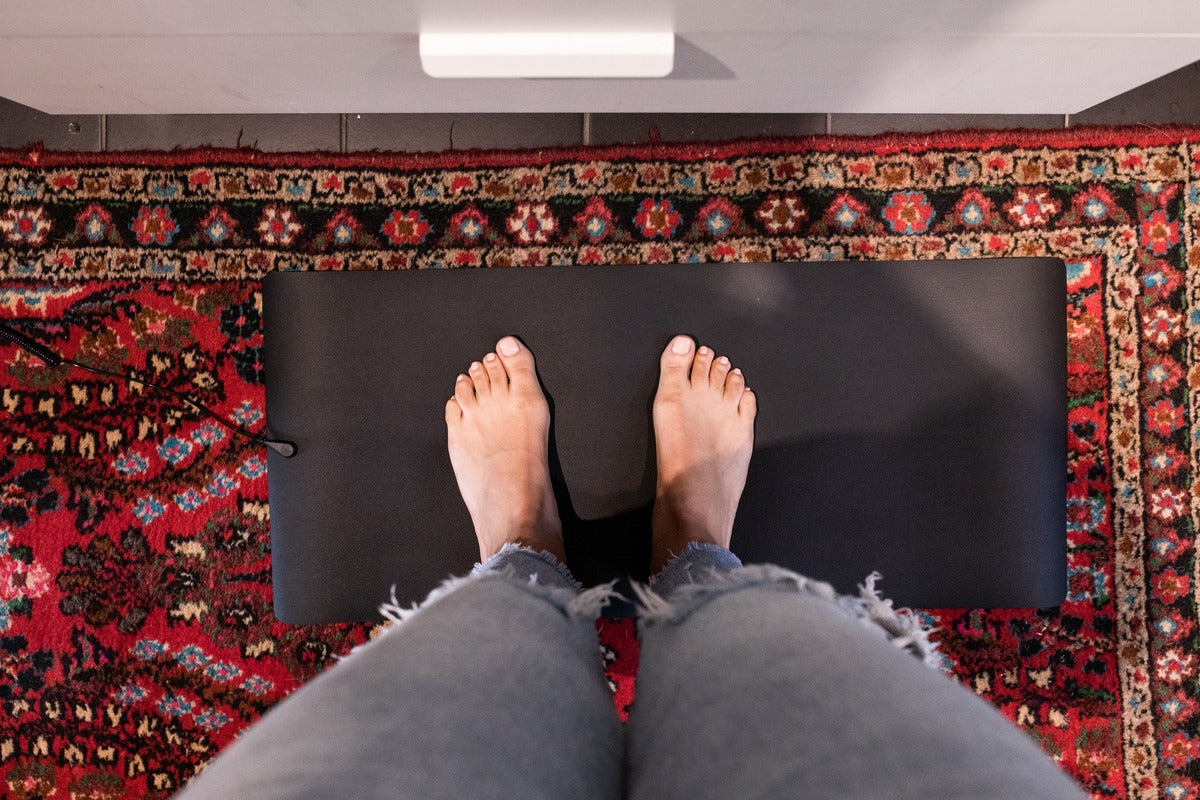
Grounding mats replicate the seated daytime sessions used in the blood and nervous system work, useful at a desk during a heavy training week.
Grounding accessories such as patches and bands mirror the targeted setups used in pain research, placed on the calf or the shoulder that keeps complaining.
Test your outlet with a plug-in checker first.
Frequently Asked Questions
Does grounding actually speed up recovery?
Research on delayed-onset muscle soreness suggests grounded participants report less pain in the days after hard effort. That is encouraging rather than settled. Individual timelines vary, and grounding works alongside sleep and food, not instead of them.
How long before I notice a difference in soreness?
Some people notice easier mornings within the first week. For others it takes three or four weeks of consistent contact before the pattern is obvious. Judge it on how day two feels after a hard session, not on night one.
How many hours a day do I need?
Contact time matters more than intensity. Overnight grounding gives you seven to nine hours without effort, which is why most of the sleep and cortisol research used that window. Thirty minutes to a few hours seated during the day is a reasonable addition.
Can grounding replace anti-inflammatory medication?
No. Grounding is a complementary wellness practice, not a treatment, and you should never stop or change a prescribed medication without talking to your doctor. Many people use grounding alongside their existing care.
Is grounding safe if I take medication or have an implanted device?
Grounding is generally well tolerated, but speak with your doctor first if you have a pacemaker or another implanted electrical device, or if you take blood-thinning medication. Some people feel mild aching or unusual tiredness for the first several nights, which typically settles within a week.
Test It on Yourself
The research points somewhere clear, and the only measurement that will ever convince you is your own. Sleep grounded for a month and pay attention to the boring signals, how the second day after a hard session feels, whether the stiffness clears before breakfast.
Earthing.com is the origin brand, founded on the work of Clint Ober, who funded much of the research described above rather than simply selling around it. Explore the grounding collection and run the experiment on your own legs.


Leave a comment
This site is protected by hCaptcha and the hCaptcha Privacy Policy and Terms of Service apply.