

Somebody you trust thinks this is nonsense.
You mentioned it once, at a table, and watched the face do the thing faces do. Maybe there was a joke about crystals. Maybe they just changed the subject kindly, which is worse. You have not brought it up since, and part of you has quietly filed the whole idea under things you are probably being silly about.
That reaction is not unreasonable, and the question deserves the boring answer rather than the enthusiastic one. So: are grounding sheets legit? The equipment is real and the physics is dull and settled. What is still open is the biology, and this page keeps those two apart on purpose, because most of the eye rolling comes from hearing them run together. The electrical side in more detail lives in what a grounding sheet actually does.
Here is what is solid, what is still a proposal, and what you can say the next time it comes up.
Are Grounding Sheets Legit? The Short Version
Yes, as a piece of equipment, and the equipment is the least interesting part of the answer.
The earth's surface carries a mild negative charge. That is not a wellness claim, it is standard atmospheric physics. The planet's surface conducts, so does the top of the atmosphere far above the weather, and the deep layer of ordinary air between them acts as an insulator. On clear days there is a slow drift of charge downward through it toward the ground. Thunderstorms are the other half. Lightning strikes somewhere on earth roughly fifty times a second, and each strike hands a load of negative charge back to the surface.
So the charge is maintained rather than left over. There is weather on the far side of the world working on it right now.
That is the physics, and it gets you exactly as far as contact. Everything after contact is a separate conversation, and a more honest one.
Why the Ground Under You Conducts at All
Soil looks like the least electrical substance imaginable. It is not.
Dig anywhere and what you find is mineral grains with water sitting in the spaces between them, and that water is never pure. It carries dissolved salts picked up off the rock it has been resting against, and salt in water means charged particles free to move, which is the whole definition of a conductor. The ground conducts because it is wet and because it is dirty.
That is also why the list of usable surfaces reads the way it does. Grass, soil, sand and unsealed concrete all carry the connection, concrete included, because it is porous and holds moisture right through. Asphalt does not, being a petroleum product. A sealed or painted floor does not, since the sealant is there precisely to keep water out. Wet sand at the tide line is about the best surface you will ever stand on.
Under all of it lies groundwater and more wet rock, and the whole mass is joined up. Which is why an electrician drives a rod into the soil rather than bolting the wire to a wall.
Why Your Skin Can Reach It
An electron in the ground is no use to you if nothing conducts.
Your body is salty, wet and conductive, which is the one contribution biology makes to this part of the story. For most of human history that was enough. Bare feet, thin leather soles, dirt floors, and the charge passed back and forth without anyone calling it a practice.
Then the soles changed. Rubber first, then plastics, then molded foam, all chosen for being cheap and light and waterproof. None of it conducts.
Put a foam sole between a person and a wet lawn and the two are as separated, electrically, as if that person were standing on a rubber mat in a workshop. The grass is right there. The charge is right there. Nothing crosses.
What You Are Actually Buying
Conductive fabric and a cord. The cord goes to the round hole in a wall socket, and that hole has run to a rod in the soil since the day the house was wired.
It is a wire between your skin and the planet, as literal as that sounds. The large half of that sentence is the planet.
If the sheet sounds like the suspicious part, notice that it does nothing your bare feet were not doing on a lawn. It keeps that contact through January, and through the seven hours you spend lying down.
What Has Actually Been Measured
Here is where a fair question turns into a fair answer, because people went and checked.
Thermal imaging of grounded participants has documented warmth over sore tissue settling down over weeks. Blood drawn before and after a couple of hours of earth contact came back with the red cells holding more charge and clumping together less, which matters because cells carrying the same charge push each other apart and spaced cells move more easily through the smallest vessels. Cortisol, the body's main stress hormone, is meant to run high in the morning and taper off after dark, and in people who slept grounded a flattened curve moved back toward its proper shape.
Those three instruments share no machinery, and they have kept landing the same way. They are small studies, and small studies deserve to be called small. The oxidative stress side of the research is a subject in its own right.
What Is Still Only a Proposal
The part nobody should oversell is the why.
Oschman, working with Chevalier and Brown, set the idea out in a Journal of Inflammation Research review. Electrons moving up out of the soil could do the job an antioxidant does, giving themselves away to molecules that are one electron short before those molecules break something. That is a hypothesis rather than a settled fact, and it is worth saying so out loud.
What keeps it interesting is that it is unexotic. Vitamin C works by donating an electron, so does glutathione, and an electron out of soil is not chemically different from either. Nothing strange has to be true about the human body for the chemistry to work, which is exactly why it can be tested instead of argued over.
What to Say When Someone Raises an Eyebrow
You do not have to win the conversation. Most of the discomfort comes from feeling like you have to defend more than you actually believe.
The claim is small. The ground holds a charge, your body conducts, shoes and floors stopped the contact a couple of generations ago, and a cord restores it. Nobody who has wired a house would blink at that sentence.
The measured results are early and the mechanism is a proposal. Saying so is not a weakness in your case, it is the reason your case is worth listening to. And if the reply is still a joke about crystals, the useful move is not more argument. It is a month, a note by the bed, and your own answer.
Making Contact in an Ordinary Week
Start with the version that costs nothing. Thirty minutes barefoot on grass, soil, sand or unsealed concrete grounds you completely. Damp ground beats dry, wet sand counts double, gardening counts.
The obstacle is not effort, it is January. The evenings shut down early, the ground goes cold, and a barefoot habit tends to end before anybody notices it ended.
If you want to know whether it is doing anything, keep the test simple. Note how you fall asleep and how you feel getting out of a chair. Some notice sleep inside the first week or two. Many feel nothing for a fortnight, which says nothing about whether it will suit them. A minority feel something less pleasant at first, mild aching or a restless few nights, and it usually settles within a week.
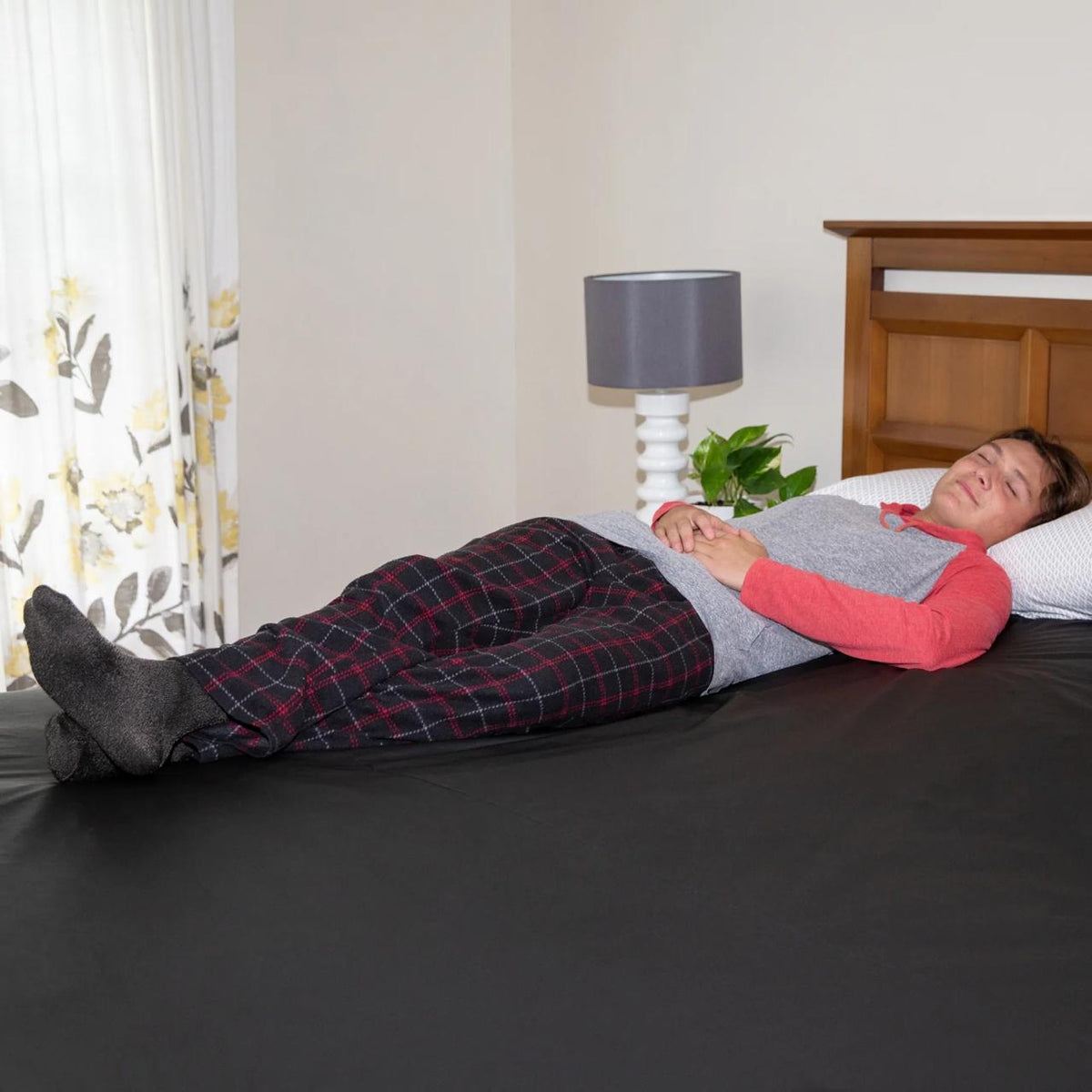
The grounding mattress cover is the largest area of contact and the plainest version of the wire to planet idea.
Grounding mats are the smaller, portable version of exactly the same connection, for a desk or an evening chair.
Grounding accessories such as patches and bands connect one spot rather than a whole body.
Test your outlet with a plug in checker first, since older houses and rewired rooms are not always wired the way the paperwork claims. Earthing products connect to the ground port alone and carry a built in safety resistor, so no electricity flows into you.
Grounding is a complementary wellness practice that supports the body's natural balance. It is not a treatment for any medical condition, and it belongs alongside your existing care.
Frequently Asked Questions
Are grounding sheets legit as a piece of equipment?
Yes. The earth's surface holds a charge, your body conducts, and a cord between the two closes a loop that used to close by itself whenever anybody walked outside barefoot. Every link in that chain is standard physics.
What makes the earth's surface negatively charged?
Lightning, mostly. Roughly fifty strikes a second somewhere on the planet carry negative charge down to the ground, and on clear days it drifts slowly back up through the air.
Does the earth's charge ever run out?
No, and the storms are the reason. The supply is being restocked somewhere on the planet while you read this, which makes it a standing arrangement rather than a battery that empties.
Can I try this without buying anything?
Yes, and it is the sensible way to start. Barefoot on damp grass connects you as completely as any sheet does. What a product buys you is the winter, the city, and the sleeping hours.
Why does damp ground work so much better than dry ground?
Because the conducting happens in the water rather than in the dirt. Soil carries dissolved salts, and salty water moves charge easily, so wet grass and wet sand connect you far better than dust does.
Decide It Yourself
Nobody at that table is going to settle this for you, and neither is this page. Give it a month, keep a short note, and let your own weeks answer it.
Earthing.com is the origin brand, founded on the work of Clint Ober, who funded much of the research described above rather than simply selling around it. Explore the grounding collection and put yourself back in touch with the ground.


Leave a comment
This site is protected by hCaptcha and the hCaptcha Privacy Policy and Terms of Service apply.