

It is two in the morning and the house is quiet. You are wide awake, you have been for forty minutes, and you already know exactly how tomorrow is going to feel.
Then it does. The alarm goes at seven and the first three hours are wading. Around nine in the evening, when there is nothing left to spend it on, the energy finally turns up, cheerful and useless.
That is a timing problem more than a tiredness problem, a body running its day a few hours out of step with the one going on around it. It is also where grounding metabolic health actually sits, further from the dinner plate and closer to the bedroom than most people expect. The nervous system side of the same story, the balance between the branch that revs you up and the branch that settles you down, lives in the work on grounding and heart health. This piece stays with the clock.
Here is what has been measured about that daily rhythm, what nobody has measured, and how a week might be built around the difference.
The Clock You Cannot See
Behind your eyes, where the optic nerves cross, sits a cluster of cells about the size of a grain of rice.
That is the master clock. Light landing on the back of the eye tells it what hour it is, and it passes the hour along to everything else. Which is why a week of late screens and dark mornings leaves you jet lagged in your own kitchen.
Here is the part most people miss. The master clock is not the only clock. Your liver keeps one. So do your muscles, your skin, even the lining of your gut. Each runs a roughly twenty four hour cycle of switching genes on and off, and each is listening for cues about when to do it.
So very little in you is constant. You are on a schedule, and you handle the same task differently at seven in the morning than at eleven at night.
Night Is the Maintenance Shift
Sleep is not the body switching off, it is the body switching tasks.
Overnight, memory gets sorted and filed, tissue gets rebuilt, and the signaling that governs appetite is squared away for the day ahead. Trim a couple of hours off for a few nights running and that last one goes wobbly fast, which is the schedule complaining rather than a failure of character.
None of it needs your attention. All of it runs to a timetable.
Why Cortisol Is the One You Can Feel
Of all the daily rhythms, cortisol is the one you have already noticed without naming.
It should climb steeply in the couple of hours before you wake, handing you the fuel and the alertness to get vertical, then fall away across the afternoon and bottom out near midnight. Steep in the morning, quiet at night. That is the shape.
What goes wrong in a stressed or badly slept life is rarely the amount of it. It is the shape. The curve flattens, so the morning rise that was meant to lift you never quite arrives, and neither does the evening drop that was meant to release you.
Read that back and you have the two in the morning problem exactly, which is why researchers who set out to study grounding and sleep ended up studying cortisol.
In early sleep research, people slept on grounded bedding in their own beds for weeks while their cortisol was sampled around the clock. Not once, but repeatedly through the day and the night, so the shape of the curve could be seen rather than guessed at.
Their cortisol drifted back toward the shape it is supposed to have. Up in the morning, down at night. Their reported sleep improved alongside it, and so did pain and stress.
That study is small, and the people who ran it say so themselves. What earns it a hearing is what it chose to measure, because a hormone sampled across a full day and night produces a shape, and a shape is harder to wish your way into than one good night.
Underneath the lab results sits a plainer idea. Steady contact with a conductive planet was one of the conditions your body developed in. Rubber soles and a bed on a wooden floor are recent. The clock is not.
Where Grounding Metabolic Health Actually Sits
Now the honest part, because this field is younger than the enthusiasm around it.
What has actually been measured in grounded people is sleep quality, the cortisol curve, nervous system balance, inflammatory markers, and the surface charge on red blood cells. That is the list. Nobody has followed grounded people for a year to see what happened to the rest of it, and a page suggesting otherwise is describing research that does not exist.
The proposed mechanism, which Oschman, Chevalier and Brown set out in their Journal of Inflammation Research review, is that electrons taken up from the ground can act as antioxidants inside the body. Nobody has demonstrated that yet, and the authors say so themselves.
What makes that less unsatisfying than it sounds is that the measurements which do exist keep pointing the same direction. A cortisol assay knows nothing about a thermal camera, and a blood smear knows nothing about either, so the fact that all three agree is worth something.
Anything you are genuinely worried about in your own health belongs with your doctor rather than a blog. Grounding is not a medicine and not a substitute for one. It sits underneath, at the level of the schedule, where sleep, morning daylight and movement do the heavy lifting. Its one advantage is position, because it takes up hours you were already going to spend flat on your back.
Building a Week Around the Clock
Start with the version that costs nothing.
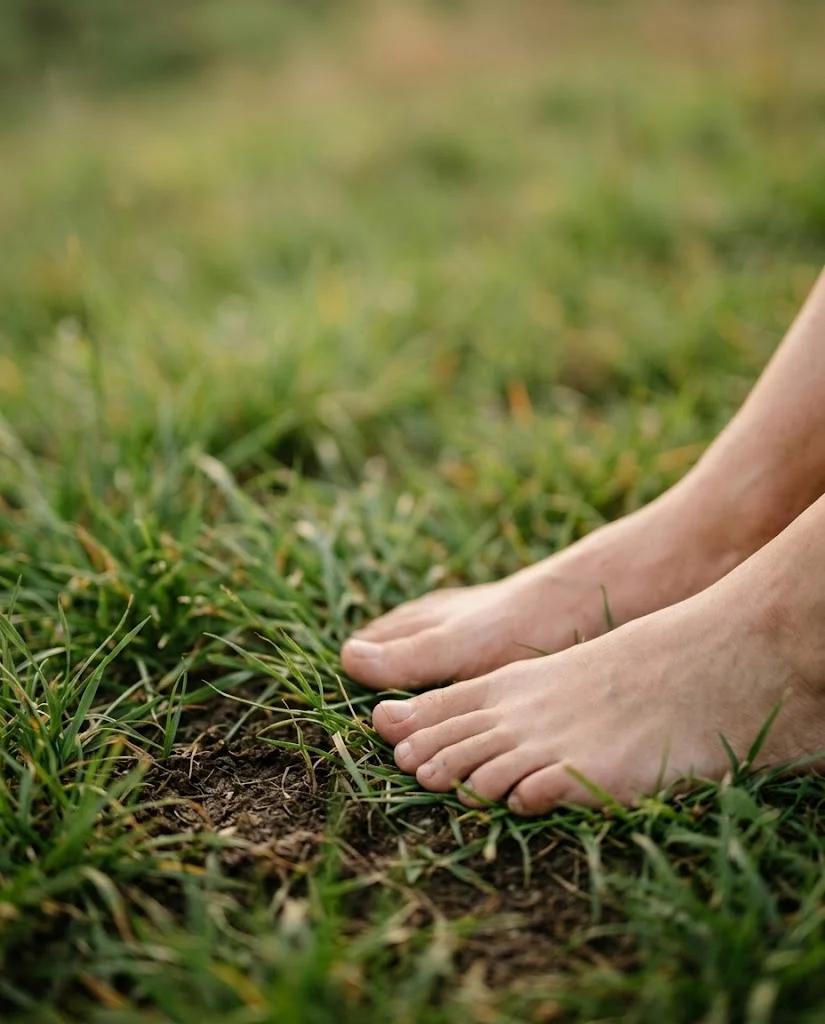
Thirty minutes barefoot on grass, soil, sand or unsealed concrete grounds you completely. Do it early if you can, because morning light outside does two useful things at once. It grounds you, and it hands the master clock the one cue it cares about most. Sealed or painted concrete will not carry it, and neither will asphalt.
A realistic week looks duller than a plan. Coffee outside on the step, shoes off, ten minutes. A walk at lunch when the weather cooperates. Gardening at the weekend, which counts twice because nobody has to remember to do it.
Then the clocks change and the whole arrangement falls apart. That is not a failure of discipline, that is November, and it is the honest case for something indoors during hours you were going to be horizontal anyway.
The First Month, Honestly
Nothing announces itself. There is no warmth at the point of contact, no tingle, no hum, and a first week spent waiting to feel it switch on is a week spent disappointed.
Sleep is what people mention first, often inside a week or two. Anything else moves more slowly, if it moves for you at all. A minority feel something less pleasant at the start, mild aching or a couple of restless nights, and it usually settles within a week.
Write down where you are starting. How long it takes you to fall asleep, how many times you wake, how the first hour goes. Four weeks of that will tell you more than any single night.
The grounding mattress cover runs all night, which is the window the cortisol work measured.
Grounding mats cover the daylight hours, and a body clock is built out of both halves.
Grounding accessories such as patches and bands are the targeted option when you want contact in one place.
Test your outlet with a plug in checker first, since older houses are not always wired the way the paperwork claims. Earthing products connect to the ground port alone and carry a built in safety resistor, so no electricity flows into you.
Grounding is a complementary wellness practice that supports the body's natural balance. It is not a treatment for any medical condition, and it belongs alongside your existing care.
Frequently Asked Questions
What does grounding metabolic health research actually look at?
Mostly the systems sitting underneath. Sleep quality, the daily cortisol curve, nervous system balance and inflammatory markers are what has been looked at. Treat it as work on the body's timing.
How are earthing and the body clock connected?
Through the daily hormone curve. Grounded sleepers showed cortisol drifting back toward its proper shape, higher in the morning and lower at night, and that curve is one of the clearest readouts of the body clock there is.
Does grounding replace sleep, daylight and movement?
No, and nothing does. Those three carry almost all of the weight. Grounding is a modifier applied on top of them, and its advantage is that it runs during hours you were already spending in bed.
Why do people say they have more energy after sleeping grounded?
Sleep is the likeliest answer. Better sleep produces the feeling of more energy more reliably than anything else, and improved sleep is among the most consistent things grounded people report. Whether expectation explains that has been tested directly.
Should I mention grounding to my doctor?
Yes, at your next appointment, and especially if you take anything prescribed. Keep taking exactly what you were given. Any question about your own health is a question for a physician rather than an article.
Let the Night Do Its Work
Your body keeps time whether you help it or not.
The clock behind your eyes, the smaller ones in your liver and your muscles, the cortisol curve that lifts you out of bed a minute before the alarm on a good week. All of it was set by the world outside, back when the world outside was the thing you slept on. Give it the two cues it grew up expecting, light in the morning and contact with the ground, then let a month tell you the rest.
Earthing.com is the origin brand, founded on the work of Clint Ober, who funded much of the research described above rather than simply selling around it. Explore the grounding collection and give your clock something steady to set itself by.


Leave a comment
This site is protected by hCaptcha and the hCaptcha Privacy Policy and Terms of Service apply.