
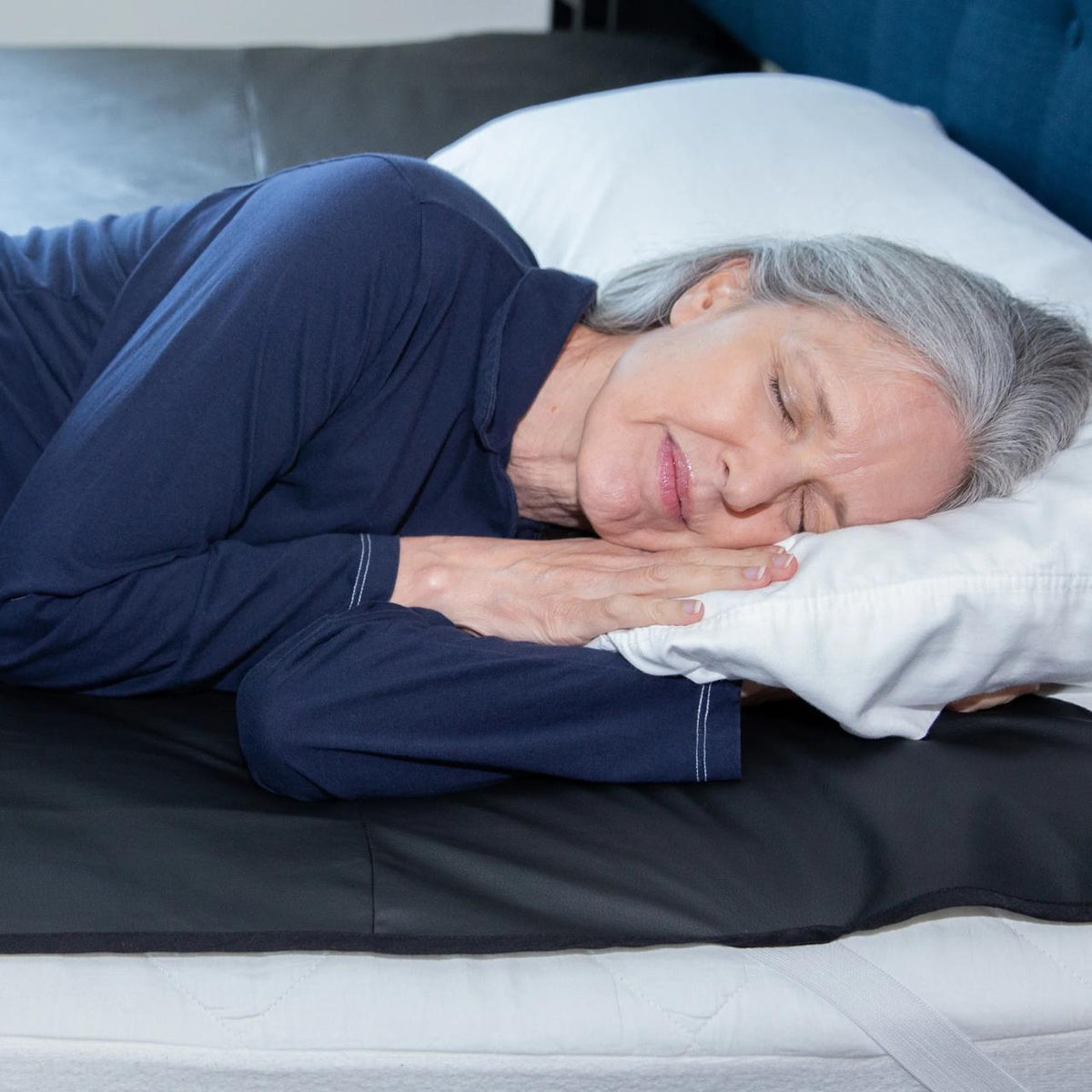
You've done everything right. The Earthing Sleep Mat or Mattress Cover is on the bed, the cord is connected, you've slipped under the covers and let out that end-of-day sigh. And then it hits you.
You're wearing pajamas.
Maybe you also love your own fitted sheet and have no intention of giving it up. Maybe you're a socks-in-bed person (no judgment, we know plenty of you). Or maybe it's January, and the idea of stretching out on a cool surface in bare skin sounded a lot more appealing back when you placed the order.
So, does that layer of fabric between you and your Earthing product break the connection?
Happily, the answer is more useful than a flat yes or no.
Bare skin gives you the quickest, most reliable connection. But a thin layer of the right fabric doesn't necessarily stand in the way of grounding.
Here's why. Natural fibers like cotton and bamboo absorb a little moisture from your skin and from the air around you. As that fabric becomes ever so slightly hydrated, it becomes more conductive, and the electrical connection can pass right through it. That's why Earthing's current setup guidance makes room for a fitted sheet, light pajamas, and even socks in the right circumstances. Earthing
The questions that actually matter are what your fabric is made of, how many layers sit between you and the conductive surface, and whether you're after the strongest possible connection or the most comfortable setup you'll actually use, night after night. (Spoiler: the second one usually wins.)
Bare Skin Is Still the Simplest Option
If you want to take every variable off the table, go skin-to-surface.
Rest a bare foot, calf, forearm, or hand directly on the conductive surface of your Earthing product and the connection begins right away, with no waiting for fabric to do anything first.
You don't need your whole body on the product, either. You just need enough contact with the conductive surface. That's why a Universal Mat works under bare feet at your desk, and why a Sleep Mat or Mattress Cover does its job even when only your calves are touching it.
Bare skin is also your best friend when you're troubleshooting. Not sure your bedding arrangement is working? Take the fabric out of the equation, test with bare skin, and you'll have your answer.
Just remember: bare skin being best is not the same as bare skin being required. There's a lot of comfortable middle ground, and the rest of this article lives there.
Can You Put a Fitted Sheet Over an Earthing Mattress Cover?
Yes, as long as you choose your sheet with a little care.
Earthing's current guidance recommends cotton, bamboo, or a cotton-polyester blend for a fitted sheet placed over a grounded Sleep Mat or Mattress Cover. While you sleep, your body naturally releases small amounts of moisture, and breathable fabrics soak some of it up. As the sheet hydrates, its electrical resistance drops enough for a grounding connection to form. Earthing
Translation: you don't have to give up the feel of your favorite bedding to sleep grounded.
There is a trade-off, though, and it's worth knowing about.
Skin on the Earthing surface is an instant connection. Slip a fitted sheet between the two and the connection now depends partly on moisture, fabric, and how much of you is actually touching it. Bare contact stays the strongest and least fussy option.
Fully synthetic sheets are another story. Polyester and microfiber absorb far less moisture than cotton or bamboo, which makes them a poor choice between you and your Earthing product. Earthing currently advises against fully synthetic sheets over its grounding surfaces. Earthing
So if you love a fitted sheet, keep it simple: thin, cotton or bamboo, and you're set.
Can You Wear Pajamas While Grounding?
Yes. Keep the pajamas.
The real question isn't whether you're wearing them. It's how much material sits between your skin and the grounded surface.
Light cotton or bamboo sleepwear absorbs your natural moisture much like a fitted sheet does. So if you're lying directly on an Earthing Mattress Cover in a soft T-shirt and shorts, you can still maintain contact through the fabric as it hydrates. Earthing's FAQ says so in as many words: pajamas can be worn while grounding. Earthing
Where things change is when the layers start stacking up.
Picture it: Mattress Cover, then fitted sheet, then head-to-toe flannel. Now there are two fabric layers between most of your body and the conductive surface. Earthing's current guidance treats that setup differently and recommends either leaving a good amount of bare skin against the fitted sheet or moving the grounding surface above the sheet instead. Earthing
Which gives us a rule worth remembering:
One thin, moisture-absorbing layer can work. Multiple layers make the connection less dependable.
If full pajamas are non-negotiable for you (and for a lot of us, they are), don't overthink fabric science. Lay the Sleep Mat on top of your fitted sheet so your pajamas are the only layer in play, or let your feet, calves, or forearms peek out.
Comfort isn't a nice-to-have here. The best grounding setup is the one you can leave in place and forget about, because that's the one you'll actually use.
What About Socks?
Good news for the cold-footed among us: socks aren't automatically a problem.
Earthing's guidance says socks can be worn on a Universal Mat because feet naturally perspire. That moisture can hydrate the sock and create a conductive path, especially with thinner socks made from natural fibers like cotton or bamboo. Earthing
The same gentle hierarchy applies, though.
Bare feet give you the fastest, most direct contact. Thin natural-fiber socks are a solid runner-up. Thick socks and synthetic materials may take longer to become conductive enough, and they add a little more guesswork.
So if you're at your desk with no particular reason to keep your socks on, slipping them off is the easy win. But if it's January and the floor is freezing, a pair of thin cotton socks doesn't automatically undo the setup.
That's a far more livable answer than telling you your grounding mat stops working the moment a sock touches it.
Why Fabric Changes When Moisture Is Added
Here's the slightly nerdy part, and it's more interesting than it sounds.
Textiles don't behave the same way electrically under every condition. Dry fabric tends to have high electrical resistance. Add a bit of moisture and everything shifts, because water carrying dissolved salts and minerals gives electrical charge a way to move. Hydrophilic fibers like cotton drink up more moisture than hydrophobic synthetics like polyester, which is one reason their electrical behavior changes so differently with humidity. Research on textile conductivity and antistatic properties has documented exactly this relationship between moisture uptake and lower electrical resistance. ScienceDirect
And no, your bedding doesn't need to feel damp for this to happen.
Normal overnight perspiration and the humidity already in your bedroom can be enough to change the electrical properties of a thin, natural-fiber layer over time. Earthing's own product-testing instructions account for this: when you test through a sheet, the company has you add a drop of water to mimic the moisture that builds up during use. Earthing
This is also why fabric type matters so much.
Cotton and bamboo hold moisture readily. Polyester and microfiber hold much less. Stack several layers and the path gets longer and harder to predict.
So the underlying principle isn't "fabric always blocks grounding." It's that conductivity depends on the material, the moisture, the thickness, and how many layers are involved.
The Bedding Setup That Makes the Most Sense
Let's make this easy. Find the line that sounds most like you.
For the strongest possible connection, sleep directly on the grounded Mattress Cover or Sleep Mat with at least some bare skin touching it.
If you'd rather keep your own fitted sheet, choose a thin cotton or bamboo one and let a reasonable amount of bare skin rest against it through the night.
If you're a full-pajamas sleeper, place the grounding mat above the fitted sheet rather than beneath it, so there's just one fabric layer between you and the conductive surface.
If you want a fitted sheet and pajamas, keep the sleepwear light enough that some bare skin still meets the sheet. Think shorts and a tank rather than fleece from neck to ankle.
What you want to avoid is burying your Earthing product under thick layers: a mattress topper, a padded protector, a folded blanket, a duvet, or several sheets at once. Earthing's setup guidance treats these differently from a thin, breathable sheet, because sheer distance and thick insulating layers keep you from making meaningful contact with the conductive surface. Earthing
The goal isn't perfection. It's a simple connection with as little unnecessary material in the way as possible.
Material Matters More Than People Think
If you take one thing from the fabric aisle, take this: cotton and bamboo are the safest conventional choices for any layer between you and an Earthing product, because they absorb moisture so readily.
A cotton-polyester blend can also work, though Earthing describes it as less optimal than fully natural, breathable fabrics.
Fully synthetic polyester or microfiber bedding should generally stay off the grounding surface. It doesn't absorb moisture well and can stay stubbornly resistive. Earthing
The same logic applies to what you sleep in.
A lightweight cotton tee is a very different thing from thick polyester fleece pajamas. A thin cotton sock is a very different thing from a heavy synthetic thermal one.
You don't have to squint at every fabric percentage on every label. Use bare skin wherever it's convenient, and reach for breathable natural fibers whenever you want a layer.
Do Lotions and Body Oils Matter?
They can, and this one's easy to miss.
The issue isn't really whether grounding works on any given night. It's about keeping the conductive surface in good shape over the long run.
Earthing advises against applying lotions, creams, and body oils right before direct contact with its mats and covers. Residue can build up on the conductive surface and gradually get in the way of performance. Along the same lines, the company recommends cleaning its carbon-based mats with mild soap and water, and skipping bleach, harsh chemicals, oils, and whitening products. Earthing
So a little routine care becomes part of a reliable setup.
If body lotion is part of your evening routine, give it time to absorb before you get into bed, or keep the freshly moisturized areas away from the spot where your skin meets the surface.
How to Know Whether Your Setup Is Actually Grounded
Here's something worth saying clearly: don't judge your connection by whether you feel tingling, warmth, a wave of calm, or anything else.
Grounding doesn't come with a built-in sensation. Some people notice something; plenty of people notice nothing at all. Neither tells you whether the electrical pathway is working.
Instead, start with the wall. Make sure the outlet itself is properly grounded using the Outlet Checker included with your Earthing setup. Earthing's product directions ask you to verify the outlet before connecting anything to it. Earthing
Then check the surface. An Earthing Product Tester confirms that the conductive surface is doing its job. If you're testing through a fitted sheet, Earthing has you dampen the test spot slightly to recreate the moisture that develops while you sleep. Earthing
That's far more useful than trying to guess at conductivity from how you feel.
And if you're ever unsure about your bedding arrangement, simplify for a night: bare skin straight onto the product, verify the outlet and the surface, then add back the layer you love.
Frequently Asked Questions
Do I Have to Sleep Naked to Be Grounded?
No. Bare skin is the simplest, most reliable connection, but you don't need full-body contact. Wear light sleepwear and leave your feet, calves, forearms, or another patch of skin exposed. Earthing also notes that thin, natural-fiber clothing can conduct as it absorbs your body's moisture. Earthing
Can I Put My Normal Fitted Sheet Over an Earthing Mattress Cover?
Yes, ideally cotton, bamboo, or a cotton blend. Bare contact gives the strongest immediate connection, but Earthing says natural body moisture can make a thin fitted sheet conductive enough for grounding. Fully synthetic sheets aren't recommended. Earthing
Can I Wear Pajamas and Use a Fitted Sheet at the Same Time?
You can, but two layers add resistance and make the setup less dependable. Earthing recommends keeping some bare skin against the fitted sheet, or moving the grounding surface above the sheet if you prefer full pajamas. Earthing
Can I Wear Socks on a Grounding Mat?
Yes. Thin cotton or bamboo socks can become conductive as moisture from your feet moves into the fabric. Bare feet are still the most direct option, and thick or synthetic socks may take longer to make the same connection. Earthing
Does a Mattress Protector Go Over the Grounding Cover?
A thick or waterproof mattress protector shouldn't sit between you and the grounding surface. Tuck substantial insulating layers underneath the Earthing product, not on top of it. A thin natural-fiber fitted sheet is a different case, because moisture can allow conductivity through that single layer. Earthing
Keep the Connection Simple
The easiest grounding setup is still the obvious one: conductive surface, bare skin, verified connection.
But real bedrooms aren't laboratories. We get cold. We're attached to our sheets. We have pajamas we love. And nobody wants a wellness habit that means rebuilding the bed every night.
The lovely part is that you don't have to.
Bare skin gives you the fastest, most reliable connection. When you want a layer between you and the product, keep it thin, breathable, and preferably cotton or bamboo. Skip fully synthetic bedding, don't stack layers, and verify your setup rather than guessing.
That keeps grounding exactly where Clint Ober always meant it to be: simple enough to slip into ordinary life, not one more routine to manage.
For overnight grounding, explore the Earthing Sleep Mat and Mattress Cover. For daytime, the Universal Mat gives you an easy contact point at your desk or on the couch. And before you rely on either, use the Outlet Checker and Product Tester so you know the connection is really there.


Leave a comment
This site is protected by hCaptcha and the hCaptcha Privacy Policy and Terms of Service apply.